

How to Get Your HVAC Company Featured in Google AI Overviews in 2026
HVAC AEO is how to rank HVAC companies on Google AI Overviews using AI SEO, HVAC SEO, and search-focused business content.
Key Takeaways
- HVAC companies rank in Google AI Overviews by building page-one search strength, publishing answer-first local content, and proving expertise with business evidence.
- Create dedicated pages for each service and location, then cover symptoms, pricing factors, timing, safety, and next steps.
- Put a self-contained answer in the first sentence, use question-shaped headings, and support claims with steps, equipment, credentials, and relevant links.
- Complete every Google Business Profile field, keep business details consistent, and earn specific reviews naming the service, location, equipment, and outcome.
- Track AI Overview impressions in Search Console, log cited pages and queries, and connect calls, forms, and booked jobs to revenue.
HVAC companies rank in Google AI Overviews by building page-one search strength, publishing answer-first local content, proving expertise, and adding focused schema. If competitors appear in AI Overviews while your company does not, you lose high-intent service calls before customers reach your website. Google grounds these answers in Search, so classic SEO remains the prerequisite: strong pages, credible local evidence, extractable answers, and technical signals that connect each service to your business. Use LABs to see whether Google AI Overviews cite your site right now, then focus on the gaps that block visibility. Just paste your URL, and keep every optimization tied to real revenue and measurable AI visibility.
How HVAC Companies Earn Citations in Google AI Overviews for Local Search
Build authoritative local content, strengthen your Google Business Profile, and measure every AI citation before competitors capture the next service call. Google AI Overviews use the same index as traditional Google search, so strong search performance creates a higher baseline probability of citation.[1] Google also favors first-hand experience, subject matter expertise, and authoritative sourcing in AI Overview content.[1]
Search is splitting: customers search Google, while other customers ask ChatGPT, Perplexity, and Google for an HVAC answer. This guide gives an HVAC business a practical path from local SEO fundamentals to AI SEO measurement.
1. Build service pages that answer local HVAC questions
Write one useful page for every high-value service and service area. A page about furnace replacement in Denver should answer cost drivers, system options, permit requirements, installation timing, and the signs that require a licensed contractor.
Use customer language in headings and concise answers beneath each heading. A frequently ask question section should address questions such as “How long does an HVAC installation take?” and “Which system fits this home?”
Include these elements on every page:
- A direct answer near the top of the website page.
- First-hand details from technicians, including diagnostic steps and common repair patterns.
- Service-area references supported by real projects, photos, and customer outcomes.
- Clear author information that supports e-e-a-t google signals.
- Internal links connecting maintenance, repair, replacement, and emergency service pages.
Google evaluates information retrieval from the same search foundation that supports AI Overview citations, so HVAC SEO must serve both human readers and retrieval systems. No schema type guarantees an AI Overview citation.[1]
2. Strengthen the Google Business Profile and local proof
Update the Google Business Profile with the exact business name, service categories, phone number, service area, hours, photos, and completed-project details. Consistent business information gives Google stronger context for local search (internet) questions about your HVAC company.
Ask every satisfied customer for a detailed review that names the service and location naturally. Respond with useful specifics instead of repeated praise, and publish project photos that show technicians, equipment, and completed work.
A durable local SEO foundation includes:
- A complete Google Business Profile for each legitimate location.
- Matching business details across reputable directories.
- Reviews that describe furnace, heat pump, ductwork, or maintenance work.
- Local pages that connect the HVAC company to real neighborhoods.
This process supports Google ranking while giving AI systems evidence about the business and its service area.
3. Publish evidence that makes the HVAC business an expert source
Show how hvac work is performed, what technicians observe, and why each recommendation fits the property. A hvac market expert should explain efficiency trade-offs, maintenance intervals, indoor-air concerns, and regional code considerations in plain language.
Use original inspection photos, technician bylines, credentials, case studies, and references to manufacturer documentation. These assets give Google AI and other systems stronger evidence than generic HVAC SEO copy.
Answer each question with a clear conclusion followed by supporting evidence. A page that explains a failed capacitor diagnosis, the measured symptom, and the repair decision gives AI search for hvac a source worth citing.
4. Measure Google AI visibility and improve cited pages
Run a one-click LLM diagnosis before competitors discover which prompts exclude your HVAC company. LABs in Be Found Everywhere monitors recommendations across ChatGPT, Gemini, Perplexity, Claude, Google AI Mode, and AI Overview in real time, giving an HVAC business one view of AI visibility.
Track prompts such as “best HVAC contractor near me,” “emergency furnace repair in Austin,” and “who installs heat pumps in Phoenix.” Record the cited sources, missing service pages, competitor mentions, and changes after each update.
Google Search Console shows AI Overview impressions for pages, while third-party tools reveal the queries that trigger citations.[1] Use those findings to improve page evidence, internal links, Google Business Profile details, and HVAC SEO coverage.
The practical loop is simple:
- Ask ChatGPT perplexity and google the same local service question.
- Compare each answer with your website and Google Business Profile.
- Build the missing page or strengthen the weak evidence.
- Recheck AI visibility and search performance.
This is how hvac companies earn durable citations: answer real questions, prove local expertise, and measure whether Google AI recommends your business.
How to Structure HVAC Website Details So Google AI Overviews Cite Your Site
Structure HVAC website details as answer-first sections that connect every service, location, and proof point to a real customer question. Clear page structure gives Google AI systems usable passages and gives your HVAC business stronger search signals.\n\nPut the direct answer in the first sentence of each section, then explain the conditions, cost factors, timing, and next action. Use question-shaped H2s and H3s that match how customers ask about furnace replacement, AC installation, emergency service, and maintenance.\n\nKeep each service-area page distinct instead of repeating one template with city names changed. State the HVAC company name, phone number, address or service area, hours, licensing details, review evidence, and completed-job examples consistently. Google AI Overviews pull data from your Google Business Profile, website, citations, and reviews.[2] Structured data helps AI systems understand HVAC business details and increases the chance of inclusion in an AI Overview.[2]
How to Track AI Overview Citations for Your HVAC Company When Appearances Fluctuate and Clicks Fall
Track AI Overview citations by pairing Google Search Console data with a fixed query log and booked-lead records. Google Search Console now reports when website pages appear in Google generative AI features, including AI Overviews and AI Mode.[3]\n\nA Search Console impression means a link to your website appeared in an AI search experience, not that a customer clicked or contacted your HVAC business.[3] The dedicated report does not currently separate AI-specific clicks or conversions, so record calls, form submissions, quote requests, and closed jobs in a separate sheet.[3]\n\nUse this tracking routine:\n\n1. Save 20 to 40 customer questions covering repair, replacement, maintenance, financing, and each service city.\n2. Record the cited HVAC website page, competing sources, answer wording, and date for every check.\n3. Connect every call and form to the query theme, service, city, and revenue outcome.\n4. Review the pattern monthly because a monthly review suits most small businesses.[3]\n\nThe non-obvious trade-off is citation frequency versus citation quality: one citation on a high-intent replacement question can produce more revenue than repeated citations on low-value informational searches.
How AI Search Evaluates HVAC Content Against Local Service Realities
Make HVAC content match the conditions customers face in each service area, because AI search evaluates usefulness against local service realities rather than generic HVAC wording. A page about furnace repair in Denver needs different evidence from a page about heat-pump installation in Phoenix.\n\nState the equipment types, property conditions, service radius, response hours, permit requirements, warranty terms, diagnostic process, and customer decision factors that apply to each market. An HVAC business earns stronger Google AI consideration when its website answers the practical follow-up questions that follow the first answer.\n\nUse a service-and-location matrix to build pages:\n\n| Page focus | Details to state | Customer question answered |\n|---|---|---|\n| Emergency HVAC repair | Response hours, covered systems, diagnostic steps | “Who handles this problem tonight?” |\n| AC replacement | System sizes, installation scope, warranty terms | “What does replacement involve?” |\n| Heat-pump service | Climate fit, backup heat, maintenance needs | “Will this system work here?” |\n\nThe expert insight is that operational limits strengthen trust. Stating that a contractor serves only specified ZIP codes prevents a broad page from attracting irrelevant searches and gives Google clearer local entity signals. This approach supports HVAC SEO, local SEO, and AI SEO without padding pages with repeated city names.
What Off-Page Sources Can Strengthen an HVAC Contractor’s Local SEO Authority Beyond Google Reviews?
Build HVAC authority through consistent third-party mentions on Reddit, Quora, LinkedIn, YouTube, trade publications, supplier pages, and neighborhood sites. These sources give Google and AI systems independent context about the HVAC contractor’s expertise, service area, and customer problems.\n\nKeep the business name, phone number, service area, and website consistent across every profile and citation. Consistent NAP data makes businesses 40% more likely to appear in the local pack.[2]\n\nUse off-page sources for evidence, not empty promotion:\n\n- Answer a homeowner’s furnace or AC question on Reddit with practical diagnostic guidance.\n- Publish a short YouTube walkthrough that names the equipment and service area.\n- Add a LinkedIn case study with the problem, work performed, and measurable energy outcome.\n- Request reviews on the Google Business Profile, Trustpilot, and Yelp after completed work.\n\nLinks still matter for Google AI Overviews, while links matter far less in pure-LLM systems than mentions, reviews, and entity authority. This distinction keeps HVAC SEO work focused on the Google search signals that support AI citation.

Show HVAC Credentials, Job Evidence, and Expert Details to Strengthen Google AI Overviews E-E-A-T Signals
Publish verifiable HVAC credentials, job evidence, and expert details on every service page before Google AI summarizes your business. Clear proof helps your HVAC business earn visibility when customers search Google, ChatGPT, or another AI system. Google AI Overview systems assess information retrieval signals across your website, Google Business Profile, and broader local search (internet) references.
An HVAC company earns stronger HVAC SEO signals when each page names the responsible contractor, service area, license details, certifications, equipment brands, and completed work. Add technician bios with practical experience, training dates, and service specialties. EPA Section 608 rules require technicians who maintain, service, repair, or dispose of equipment that can release refrigerants to hold certification.[4]
Build a job-evidence block for each major service:
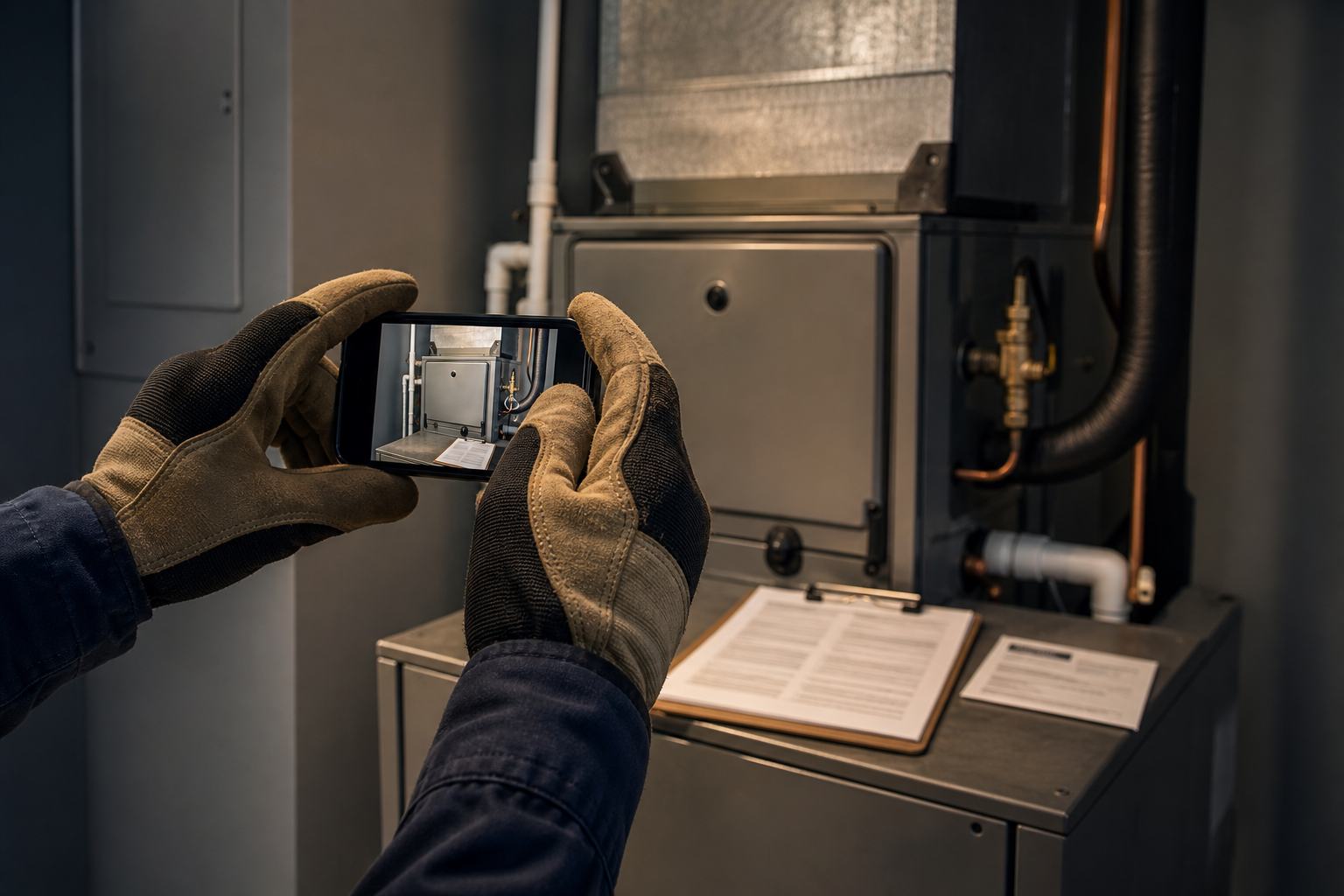
- State the customer problem and diagnostic process.
- Identify the HVAC system type, age, symptoms, and repair performed.
- Add original photos with descriptive captions and dates.
- Explain the safety check, efficiency test, and customer handoff.
- Link the service page to the relevant Google Business Profile listing.
This structure gives Google an answer it can extract, while giving AI systems enough context to connect the HVAC company with a specific service and location. A strong HVAC SEO page answers the question before a visitor asks it, rather than hiding expertise behind broad sales language.
Review every page against an e-e-a-t google checklist: experience shown through job records, expertise shown through technical explanation, authoritativeness shown through credentials, and trust shown through transparent policies. Your HVAC company should also maintain consistent business details across Google Business Profile, directories, and local pages. Consistent evidence supports Google ranking and improves AI visibility across search surfaces.
How to Keep HVAC Rebate, Code, and Safety Claims Current, Sourced, and Featured Snippet Ready
Attach a dated source, reviewer name, and review schedule to every HVAC rebate, code, and safety statement so Google and AI systems can verify the answer. Unsupported HVAC advice weakens trust, creates compliance exposure, and sends a business owner’s audience toward a competitor. Advertising statements must be truthful, non-deceptive, fair, and supported by solid proof.[5]
Create a source register for each HVAC page with these fields:
| Topic | Source to cite | Review trigger | Page treatment |
|---|---|---|---|
| Federal refrigerant rules | EPA Section 608 requirements | EPA rule update or annual review | Short answer with linked source |
| State or city code | Named authority having jurisdiction | Code revision or permit change | Service-area note with jurisdiction |
| Utility rebate | Named utility or program administrator | Program funding or deadline change | Eligibility, amount, and expiration date |
| Safety procedure | Manufacturer manual or recognized authority | Equipment revision or annual review | Step list with hazard warning |
The hidden trade-off is brevity versus qualification. A one-line answer earns a feature snippet format, but a rebate answer without income limits, equipment criteria, installation dates, or funding status misleads readers. Write the direct answer first, then add the conditions that change eligibility. This format serves information retrieval while keeping the HVAC business accountable.
Use a review workflow that assigns one HVAC market expert to technical pages and one compliance reviewer to promotional pages. Name the reviewer and display the last reviewed date near the answer. Add a “frequently ask question” section only when the wording reflects customer language, then answer each question in 40 to 60 words before expanding with detail.
For the ai search for hvac, write one precise answer for each service and city combination. Google AI Overview systems, ChatGPT, perplexity ai, and other tools compare corroborating sources, so align service facts across the website, Google Business Profile, and directory listings. Use the phrase chatgpt perplexity and google in an internal audit checklist, not as customer-facing filler.
Track every change in a revision log. When a rebate ends, update the page, structured data, internal links, and Google Business Profile post on the same day. When a code changes, explain the effective date and affected equipment. When a safety instruction changes, replace outdated HVAC guidance and record the source.
This process strengthens hvac seo and ai seo without stuffing repeated terms. It also gives Google a current answer, gives AI search a defensible source, and gives your HVAC company a practical way to protect visibility, trust, and lead quality.
Choose Relevant Schema Types and Add the Right Information to Help Google AI Overviews Rank HVAC Contractors
Add specific LocalBusiness schema, service details, and consistent company information to help Google and AI systems interpret an HVAC business. Schema supports entity understanding, but useful answers still depend on clear HVAC SEO pages and strong local evidence. Google recommends using the most specific LocalBusiness subtype possible.[6]
Use this schema map for an HVAC business:
| Schema type | Information to add | HVAC search scenario |
|---|---|---|
LocalBusiness | Business name, physical address, phone number, hours, website URL | Google searches for an HVAC contractor near a service area |
HomeAndConstructionBusiness | HVAC services, service area, contact details | Google interprets heating and cooling expertise |
Service | Furnace repair, AC installation, ductwork, emergency repair, service locations | AI Overview connects a service question with a relevant page |
FAQPage | Direct answers to genuine customer questions | Google and AI systems parse common HVAC concerns |
Organization | Legal business name, logo, website, social profiles | AI search connects brand references across sources |
Google identifies name and address as the only required LocalBusiness fields.[6] Add complete fields instead of filling every possible property, because Google prioritizes fewer complete recommended properties.[6]
Keep the business name, address, phone number, service areas, and hours identical across the website, Google Business Profile, directories, and service pages. Consistency strengthens local search signals for an HVAC company and gives information retrieval systems fewer conflicting records to process.
Use crawlable, indexable image URLs for every image referenced in structured data.[6] Add service-area photos, technician credentials, equipment images, and branded visuals only when each image supports a page’s answer. Google states that no special schema.org structured data is required beyond its general guidance.[6] Schema improves machine-readable context, while useful HVAC SEO content supplies the substance that Google AI Overview and AI search need.
How to Map HVAC Repair Questions to Service Pages Google AI Overviews Can Cite Using Large Language Model Data
Map every HVAC repair question to one focused service page, then write the answer in the exact language customers use in search and AI tools. A furnace-not-heating question needs a furnace repair page, not a broad HVAC page. A low-airflow question needs a ductwork or blower diagnosis page when that service exists.
Start with customer language from calls, chat transcripts, Google Business Profile messages, reviews, Search Console queries, and large language model prompts. Ask ChatGPT, Perplexity AI, and Google variations such as:
- “How do I know whether my furnace needs repair or replacement?”
- “Why is my AC running but not cooling my house?”
- “Who provides emergency HVAC repair near me?”
- “How much does a heat pump repair visit involve?”
The non-obvious HVAC SEO insight is to map decision boundaries, not just symptoms. AI systems need explicit distinctions between diagnosis, repair, replacement, maintenance, and emergency service. A page that explains when a homeowner needs a technician, what the inspection covers, and which conditions require replacement gives information retrieval systems more quotable passages than a page built around repeated service terms.
Build one answer block for each question. State the likely cause, safe homeowner checks, technician action, service area, and next step. Do not provide instructions that invite unsafe electrical, gas, or refrigerant work. Add internal links from symptom pages to the matching HVAC service page and from the service page to the relevant Google Business Profile signals.
| Customer question | Dedicated page | Evidence to include |
|---|---|---|
| Furnace blows cold air | Furnace repair | Diagnostic steps, repair boundaries, service locations |
| AC runs without cooling | AC repair | Common causes, inspection scope, appointment details |
| Uneven room temperatures | Ductwork service | Airflow symptoms, duct inspection, repair options |
| Emergency loss of heating | Emergency HVAC repair | Response area, safety guidance, phone details |
Use E-E-A-T Google signals through named technicians, licenses, certifications, service photos, dated case examples, and clear author review. Reference a local HVAC market expert when that person provides verifiable technical review, not as decorative authority. A feature snippet format with a concise answer helps scanning, but a complete page supplies the context AI Overview systems need.
For businesses losing leads to competitors who rank higher in Google or appear in AI recommendations without knowing it, this mapping process connects search visibility to real revenue. Track whether Google AI Overview, ChatGPT, Perplexity AI, and other AI systems mention the HVAC company, service, and location. Compare those answers with the website and Google Business Profile each month.
This guide works for an HVAC business serving one city or many nearby areas. Create location-specific pages only when each page contains distinct service evidence, local details, and a useful answer. Thin duplicate pages weaken HVAC SEO clarity and make it harder for Google AI Overview systems to select a source.
Final Thoughts on How to Rank HVAC Companies on Google AI Overviews
If your HVAC pages do not earn page-one Google rankings, related-question coverage, and local trust, Google AI Overviews have less reason to cite your business, regardless of how strong your claims sound. To follow How To Rank HVAC Companies On Google AI Overviews, build answer-first service pages, connect each location and proof point to a real customer question, show credentials and completed work, and add focused FAQPage, HowTo, Article, and LocalBusiness schema alongside consistent business details and credible reviews. Then monitor whether Google actually cites those pages, refine weak answers, and keep every operational claim current. Be Found Everywhere’s LABs visibility tracking and one-click diagnosis give you a practical way to check AI Overview appearances, so you can make informed improvements and keep control of search visibility.
Frequently Asked Questions
How Should HVAC Content Be Structured So Google Can Extract a Clear Answer for an AI Overview?
HVAC businesses that bury the answer in long service copy give Google AI fewer usable signals, so competitors show up first for urgent searches. Structure each page around one service and location, then open with a 40-60-word direct answer. Follow with clear headings, process steps, costs, service limits, FAQs, and supporting proof written in present tense. This structure helps rank HVAC companies on Google AI Overviews.
How Can an HVAC Company Tell Whether It Is Appearing in AI Overviews for Its Target Service and Location Queries?
Without prompt-level tracking, an HVAC business cannot tell whether Google AI recommends it while competitors capture high-intent calls. Track a fixed set of service-and-city searches each week, record the cited businesses and sources, and compare results by device and location. Pair those checks with Search Console, analytics, call tracking, and a citation log to measure AI visibility and real revenue. This shows how to rank HVAC companies on Google AI Overviews with evidence rather than guesswork.
What Should an HVAC Service-Area Page Include to Be Useful to Both Local Customers and Google AI Overviews?
Thin service-area pages send local customers back to broader directories and give Google AI little context about who serves them. Build one useful page per priority area with the service promise, neighborhoods covered, response times, licensing details, local proof, FAQs, internal links, and a clear next step. Connect it to the Google Business Profile, map listing, and relevant service pages so local SEO signals reinforce one another.
What Off-Page Sources Can Strengthen an HVAC Company’s Local Authority Beyond Google Reviews?
Without third-party references, an HVAC business has a weaker local authority signal beyond Google reviews, and competitors earn more trust from both customers and LLMs. Build a backlink network through manufacturer directories, licensing boards, trade associations, chambers of commerce, local news, supplier pages, and community sponsorships. Keep anchor text natural and consistent, and ensure every listing names the same business, service areas, phone, and website.
Which HVAC Credentials, Job Evidence, and Expert Details Provide Credible E-E-a-T Signals on a Website?
Missing credentials and job evidence make an HVAC website look interchangeable, so cautious customers choose a better-documented provider. Publish license numbers, certifications, technician bios, years in the trade, training, before-and-after photos, equipment details, permits, and customer-approved project summaries. Add author names, review dates, service locations, and first-hand explanations from qualified technicians. These details give Google and AI strong E-E-A-T signals.
Sources Cited
- "Google Search Central's AI Overviews Guidance: How to Get Cited." Stackmatix, https://www.stackmatix.com/blog/google-search-central-ai-overviews-guidance.
- "How to Rank Higher in Google Local Search (2026 Guide)." Merchynt, https://www.merchynt.com/post/google-local-search-ranking-guide.
- "Google Search Console Can Measure AI Visibility. Do Not Mistake It for Results.." Magic Mile Media, https://magicmilemedia.com/blog/2026/9/6/google-search-console-can-measure-ai-visibility-do-not-mistake-it-for-results.
- "Section 608 Technician Certification Requirements | US EPA." US EPA, https://www.epa.gov/section608/section-608-technician-certification-requirements.
- "Advertising and Marketing." Federal Trade Commission, https://www.ftc.gov/business-guidance/advertising-marketing.
- "Local Business Schema: Example, Types & How to Add It (2026)." SEOs Hut, https://seoshut.com/blog/local-business-schema/.