
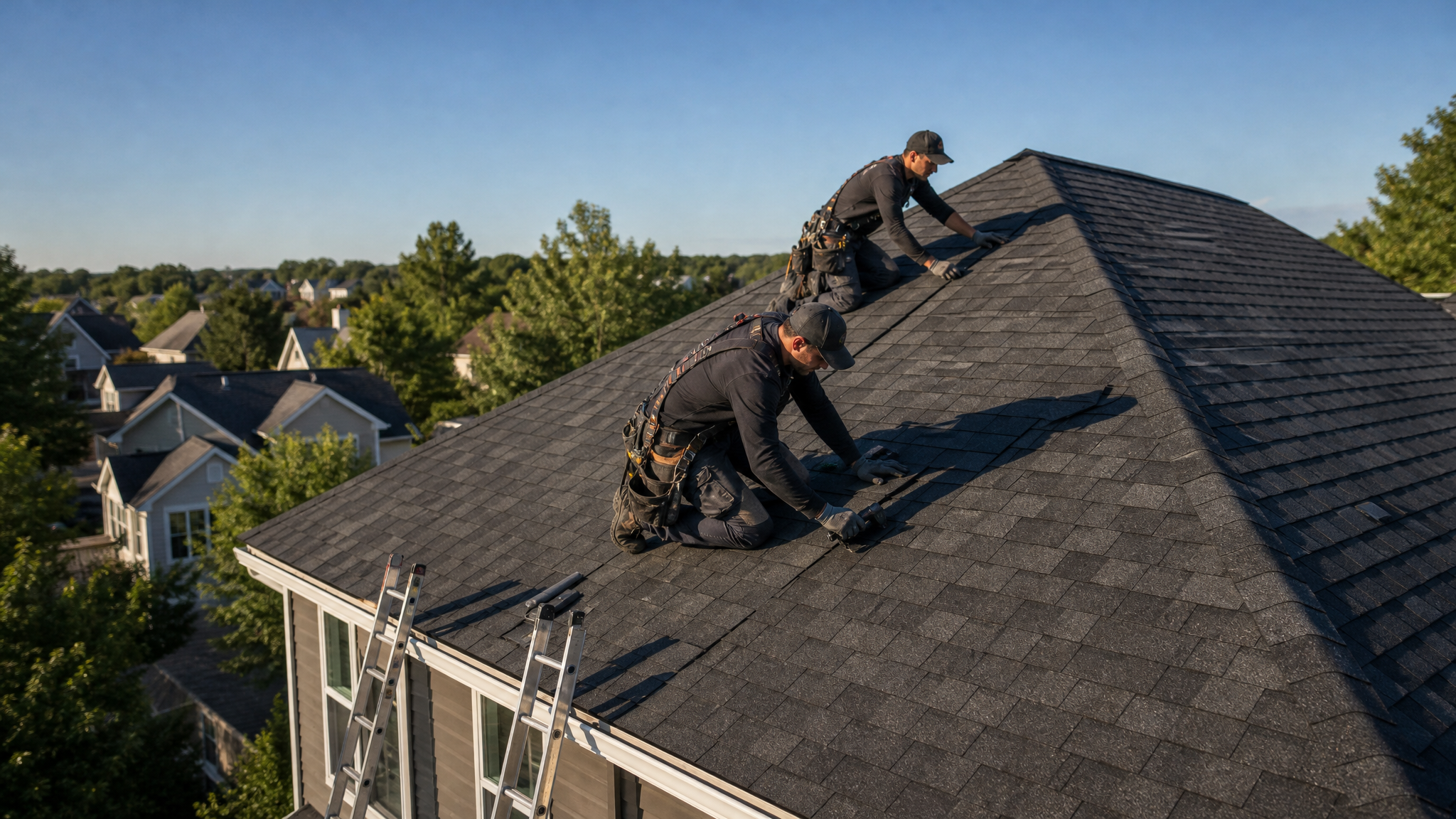
How to Get Your Roofing Company Into Google AI Overviews in 2026
How to rank roofers on Google AI Overviews is an SEO process for improving a roofing company’s visibility in Google’s AI-generated search summaries.
Key Takeaways
- Without page-one visibility, Google has little reason to cite a roofer; build relevant service pages, answer questions directly, strengthen local proof, and track citations.
- Google generates AI summaries for 53% of searches with 10 or more words, versus 8% for one- or two-word searches.
- Without consistent business details and independent reviews, local relevance weakens; sync business profiles, citations, service areas, and project evidence.
- Without extractable answers, Google struggles to cite roofing pages; lead with direct responses, question-shaped headings, concise sections, and verifiable details.
- Without measurement, roofing companies cannot connect AI visibility to revenue; track citations, page-one rankings, calls, estimate requests, and booked inspections.
Roofers rank in Google AI Overviews by earning page-one organic visibility first, then publishing clear, evidence-backed answers Google can extract and cite. Competitors already appearing in those summaries take attention before prospects reach standard results, while invisible roofing companies lose leads without knowing where they went. Google AI Overviews relies on Search, so shortcuts do not replace strong local SEO, credible reviews, clear service-page answers, and technical signals Google can verify. Track that visibility with real data, then tighten the highest-leverage gaps. Just paste your URL, define the roofing searches that drive real revenue, and build from what Google already recognizes.
How To Rank Roofers On Google AI Overviews
Rank your roofing company in Google AI Overview by building local authority, answering roof questions clearly, and proving service-area relevance. Google search is splitting in two, and AI visibility now affects whether a customer notices your company before visiting a search result. Google users clicked a traditional search result in 8% of visits when an AI summary appeared, compared with 15% when no AI summary appeared.[1]
A roof business owner needs an SEO strategy that connects Google, local search, and AI search instead of treating each channel as a separate campaign.
Assess How Google AI Mode Is Changing Local Roofing Search Visibility
Measure Google AI Overview visibility before changing your roofing SEO strategy. Google AI Overview changes a local search result from a list of links into an answer that selects sources, summarizes services, and directs attention toward a smaller set of companies. Google users who encountered an AI summary clicked a traditional search result in 8% of visits, compared with 15% when no summary appeared.[2]
Track the searches that trigger an AI overview
Long, specific searches are the immediate priority for a roofer. Google generated an AI summary for 53% of searches containing 10 or more words, compared with 8% of searches containing one or two words.[2] Track queries such as “who repairs hail damage on roofs in Plano” and “how much does roof replacement cost in Plano” instead of tracking only “roofer Plano.”
Google AI Overview citations also spread visibility across several sources. Google reported that 88% of AI summaries cited at least three sources, while only 1% cited one source.[2] A roofing company needs relevant service pages, local evidence, and answers that Google can extract without guessing.

Separate Google visibility from other AI visibility
Google AI search depends on Google’s organic index, so local SEO, technical optimization, topical coverage, and credible links remain essential. Reviews, consistent business details, and a complete Google Business Profile strengthen local visibility for a roofer competing in a crowded search result.
Be Found Everywhere uses LABs to monitor whether a company appears in AI recommendations across Google AI Overview, Google AI Mode, ChatGPT, Gemini, Perplexity, and Claude. Use that diagnosis to see why a company wins or disappears from an AI search, then connect each gap to a page, review, citation, or local SEO task.
This process shows how to rank in ai overview without treating every AI engine as the same system. Google rewards search-grounded relevance, while other AI systems weigh broader entity mentions differently.
Improve Your Roof Business’s Ranking on Google Search Results
Raise your roofing company’s page-one Google visibility before targeting an ai overview, because Google uses organic search relevance as its foundation.
Google’s organic search result remains the entry point for Google AI visibility. A local SEO strategy should connect service pages, location pages, internal links, fast mobile performance, and useful roof guidance around one clear topic. Google’s Helpful Content System rewards content that serves a real audience need instead of content created mainly to manipulate rankings.[3]
Start with the search terms that signal revenue, such as emergency roof repair, roof replacement, commercial roofing, and storm damage inspection. Build one focused page for each service and local market rather than forcing every term onto one page. A roofer earns stronger visibility when each page gives Google a clear reason to rank the company for a specific search result.
Use this optimization sequence:
- Map service and local keywords to dedicated pages.
- Improve titles, headings, internal links, and mobile speed.
- Add relevant schema to clarify each page for Google and improve search result visibility.[3]
- Check organic rankings before judging ai overview progress.
How Do I Rank My Roofer Website in AI Search?
Build a page-one organic search foundation, then make every roofing page specific, verifiable, and easy for Google AI to interpret.
- Target one local need. Create a page for roof replacement in each served city, with service details, material options, project conditions, and a direct next step. A company that serves Dallas and Fort Worth needs distinct local pages with genuine local details, not copied paragraphs.
- Write for the search result. Answer the main question in the opening sentence, use question-shaped H2 and H3 headings, and cover related People Also Ask questions. Clear H1-H3 headings improve content structure and user navigation.[3]
- Prove local relevance. Keep the Google Business Profile, address, service area, phone number, and website details consistent. Add project evidence, licenses, warranties, author credentials, and dated updates so Google can assess the company’s expertise.
- Measure the right signal. Track page-one rankings, qualified calls, form submissions, and rank in ai overview for priority queries. Google AI Overview visibility follows useful organic pages, not empty keyword repetition.
This ai search process gives a roofer a repeatable local SEO strategy. Google evaluates helpfulness sitewide, so one weak content batch can lower rankings across the company website.[3]
Sync Your Google Business Profile With Your Website to Strengthen Local SEO for How To Rank Roofers On Google AI Overviews
Sync your Google Business Profile with your website before asking Google to rank your roofing company in an ai overview. Google cross-checks business details across online sources, so mismatched names, addresses, or phone numbers weaken local visibility.[4] Consistent NAP data gives Google one clear entity to connect with each roofing service page and search result.
Use this local SEO checklist:
- Match the company name, address, phone number, service area, and website URL across the Google Business Profile, website, Yelp, Facebook, Apple Maps, Bing Places, and Better Business Bureau.[4]
- Select the most accurate primary category and add at least 10 geotagged roof photos.[4]
- Publish two Google posts each month and respond to every review.[4]
- Link each service area to a matching page with consistent roof repair, replacement, and inspection details.
This optimization gives Google structured local evidence before an ai overview evaluates which roofer answers a nearby search.

Keep Ownership of Local Listings and Citation Assets When Outsourcing SEO to a Roof Company
Keep the roofing company as the owner of every Google Business Profile while an SEO company receives manager access. A business owner can grant an organization permission to manage a profile without transferring ownership.[5] This arrangement protects local visibility when a contractor, freelancer, or agency employee leaves.
Control these assets directly:
- The primary Google account, recovery email, and verification records.
- The Google Business Profile, website domain, phone number, and review responses.
- Directory logins for Yelp, Angi, Facebook, Apple Maps, Bing Places, and the Better Business Bureau.
- A record of every citation URL, login, category, service area, and approved company detail.
The non-obvious trade-off is access speed versus asset control. An agency-owned profile gives an SEO team faster administrative control, but a roof business loses leverage when the relationship ends. A manager role gives the SEO team enough access for posts, photos, categories, and updates while the company retains the listing history and reviews. Google supports removing employee access without losing profile ownership when profiles use an organization account.[5]
Audit NAP consistency monthly because inconsistent phone numbers or addresses across Yelp, Angi, and the BBB suppress map pack eligibility directly.[4] Consistent local citations strengthen the entity signals Google uses for ai search and an ai overview.
Get Reviews That Prove Your Roofing Work and Local Search Credibility
Ask every satisfied customer for a specific, honest review describing the roof problem, service area, and completed work.
Detailed reviews give Google clearer local signals and give an AI overview evidence that a roofer serves real customers. Google uses review language, Google Business Profile details, and independent references to understand whether a company fits a local search result. A roof business owner who collects reviews consistently builds visibility across Google search and AI search without relying on vague praise.
Never buy or script positive reviews. Fake positive reviews used to promote a product are endorsements under federal advertising guidance.[6] Ask for an accurate account, invite customers to mention the city and service, and respond with useful project details.
Build Independent Confirmation of Roofing Credentials, Service Areas, and Project Experience
Give Google and AI independent proof that your roofing company serves defined locations and delivers the work described in customer reviews.
A review alone does not establish licensing, insurance, project experience, or a service area. Build a confirmation set from sources Google and AI search systems can connect:
- Link your company name to state license records, manufacturer credentials, permit records, and local trade directories.
- Create project pages naming the roof type, city, neighborhood, repair scope, materials, and completion date.
- Use original photographs with descriptive captions instead of stock images or generic claims.
- Keep your Google Business Profile service areas, phone number, website, and company name consistent.
New York’s license database supports searches by individual name, county, city, or ZIP Code, and the database states that its information is current through October 22, 2026.[7] This verification step is an overlooked local SEO strategy because exact names and locations help Google associate a company with a local search result. A roof business owner seeking to rank in ai overview should treat every credential page as evidence for an ai overview for local search result, not as a sales page. That distinction matters in google ai overview, where AI summarizes corroborated facts rather than simply repeating a company’s claims. Review the full customer journey before asking for feedback: request the review after the final inspection, when the customer can describe the completed roof accurately. Early requests produce faster volume but weaker project detail, while later requests produce richer evidence with fewer responses. This trade-off shapes visibility, search relevance, and local SEO optimization.
Include Clear, Extractable Answers on Your Roofing Service Page for AI Overview and Local Search
Answer each roofing question in the first sentence so Google can extract a complete response for an ai overview. Keep every answer specific to the roof, service area, customer concern, and company process. Google evaluates whether content answers the question people ask and satisfies the searcher without sending the searcher back to another search result.[8]
Use question-shaped H2 and H3 headings for local queries such as “How much does roof replacement cost?” and “How quickly can a roofer repair storm damage?” Follow each heading with a direct answer, supporting details, and a short next step. This structure strengthens local seo, improves ai search visibility, and gives Google clear passages to assess when selecting a search result. A roof business page that hides its answer beneath general marketing copy makes optimization harder and reduces visibility.
Audit and Correct Inaccurate Roofing Details Appearing in Google AI Overviews
Audit every ai overview that references your company, roof services, prices, service areas, or response times, then correct inaccurate details on the page Google uses as evidence. A wrong service area can send a valuable local search to the wrong company, while an outdated emergency number can turn a qualified lead into a lost search result.
Use this review process:
- Search Google from the cities and devices your customers use, and record each ai overview, cited page, claim, and search result.
- Compare every claim with the relevant service page, Google Business Profile, and current business records.
- Rewrite unclear answers in the visible page copy, then request recrawling after material changes.
- Check the ai overview again after Google updates the page’s search presence.
The overlooked trade-off is answer precision versus service breadth. A company that lists “all roofing services” without separating roof repair, replacement, inspection, and insurance support gives Google weaker passages to cite. Create one focused section for each service, location, and customer question. Keep local details consistent across the website and Google Business Profile. Structured data must accurately represent visible, current page content; misleading or hidden markup can trigger a manual action.[9] This audit helps a roofer rank in ai overview results without relying on unsupported claims, and it gives the business a defensible local seo strategy for Google ai search.
How AI Overviews Change the Way Roofers Get Found on Google
AI Overviews change roofing visibility by answering searches before standard links, so a company must earn citations and clicks differently.
Google’s AI summary draws attention away from the traditional search result and toward a short answer supported by selected pages. Google users who encountered an AI summary clicked a traditional search result in 8% of visits, compared with 15% without a summary.[10] A roofing company must rank organically, answer the query directly, and support claims with local proof to rank in an AI Overview. This strategy makes local SEO, technical optimization, and useful roofing content work as one system.
What Roofing Sites Google Pulls Into AI Overview Results
Make every roofing page easy for Google to quote by pairing page-one SEO with concise, evidence-backed answers.
Google’s AI Overview selects pages that demonstrate relevance, topical authority, and clear information architecture. A roofing company earns stronger visibility when a service page answers a question in its opening sentence, uses question-shaped H2s and H3s, and supports instructions with FAQPage, HowTo, Article, or LocalBusiness schema. Fast mobile performance, quality backlinks, E-E-A-T signals, and consistent local details reinforce that page. A complete Google Business Profile, local reviews, and consistent name, address, and phone data strengthen the same local search signal.
Why AI Overviews Appear Before Traditional Roofing Search Results for Roof Business Owners
Treat an AI Overview as Google’s answer layer, because Google places the summary above the traditional search result when the query needs a direct explanation.
Google users who encounter an AI summary click a traditional search result in 8% of visits, while users without a summary click one in 15% of visits.[10] Google users click a link inside the summary in only 1% of visits, so visibility inside the answer does not replace a strong destination page. Roofing companies need answer-first content, local evidence, and a clear next step for searches about leaks, inspections, repairs, and replacement costs. AI search rewards concise answers, while local SEO earns the underlying relevance.
Optimize Roofing Content for How To Rank Roofers On Google AI Overviews
Answer the exact roof questions customers ask so Google can use your company as a source in an ai overview. Google rewards useful, clear information, while local visibility depends on matching search intent across Google search and ai search.
A roof business owner needs one strategy for Google search, Google AI, and local search (internet), not separate pages for every channel.
Track How To Rank Roofers On Google AI Overviews With Citations and Qualified Leads, Not Rankings Alone
Track AI Overview impressions, citations, and qualified roofing leads together before changing your local SEO strategy. Google AI Overview visibility shows whether Google selects a company for an answer, while qualified leads show whether that visibility drives revenue. A ranking report alone cannot show either outcome.
Losing leads to competitors who rank higher in Google or appear in AI recommendations without knowing it’s happening makes measurement essential for roofing companies, agencies, and local business operators. Track every search result that names your company, links to your site, or generates a call request.
Track AI Overview impressions in Google Search Console
Google Search Console’s initial Search Generative AI Report measures how often pages appear within AI Overviews and AI Mode, while impressions count appearances in AI-generated search features.[11] Google reports more than 2.5 billion monthly active AI Overview users, making AI visibility a measurable business priority.[11]
Google does not provide clicks, click-through rate, average position, or query-level reporting in the initial release.[11] Treat AI impressions as an early visibility signal, then connect website analytics, call tracking, and form submissions to identify qualified local demand.
Record citations and local search visibility
Run a fixed weekly test set covering roof repair, roof replacement, emergency roof service, and city-specific searches. Record whether Google cites the company, which page receives the citation, and which competitors appear in the same AI Overview.
A roofer can rank in AI Overview for one service and disappear for another, so one keyword report cannot represent total visibility. Compare Google Business Profile actions, organic search result clicks, branded search growth, and phone calls by service area.
Judge the strategy by qualified leads
Use a simple measurement sheet with these fields:
- AI visibility: AI Overview appearances, cited URLs, and citation frequency.
- Local SEO reach: organic search result impressions, page-one rankings, and Google Business Profile actions.
- Revenue signals: qualified calls, estimate requests, booked inspections, and closed roofing jobs.
A roofing company should increase content optimization when citations rise without qualified leads, and repair service relevance when leads rise without AI visibility. This decision framework shows why a roofer is winning local search and how to rank more precisely against larger companies.
Make How to Rank Roofers on Google AI Overviews Actionable
If your roofing company does not earn page-one visibility, Google has little reason to cite it in an AI Overview, and customers find competitors before they reach your website. How To Rank Roofers On Google AI Overviews starts with the fundamentals: build relevant, technically sound service pages, answer each question in the first sentence, use question-shaped headings and structured data, keep your Google Business Profile and website details consistent, and collect specific customer reviews. Then measure whether Google AI Overviews cite your business, which pages and sources support visibility, and whether that exposure produces qualified leads. Take these steps in sequence instead of chasing an isolated ranking, and you create a clearer path from local search relevance to AI citations and customer action. Review your current visibility and choose the highest-leverage improvement to make next.
Frequently Asked Questions
How Can I Identify Which Roofing Searches Are Likely to Trigger an AI Overview and Worth Targeting?
Without targeting the right searches, your roofing business spends time optimizing pages that never earn AI visibility. To rank roofers on Google AI Overviews, prioritize complex questions about roof repair costs, storm damage, materials, timelines, warranties, and whether replacement is necessary. Check Google results manually, record recurring AI Overview topics, and build pages that answer those questions clearly for local customers.
How Can I Check Whether These Changes Are Improving My Roofing Business’s Visibility in Google AI Overviews?
Without measurement, you cannot see whether competitors are taking leads before your business appears in search. Track target queries in Google Search Console, local rank tools, and a fixed set of AI prompts, recording citations, linked pages, calls, form fills, and qualified leads. To rank roofers on Google AI Overviews, connect visibility gains to real revenue and Google Business Profile actions.
Which Schema Types Are Useful for a Roofing Company, and What Can Schema Realistically Do for AI Overview Visibility?
Missing structured context makes it harder for Google to interpret your roofing business, services, and location. Use LocalBusiness or RoofingContractor schema, Service schema for each core offering, and FAQPage schema when the visible page contains genuine questions and answers. Schema supports clearer machine understanding for Google and LLMs, but it does not guarantee rankings, citations, or AI Overview inclusion.
What First-Hand Evidence Can a Roofer Add to Show Real Expertise and Trustworthiness to Google?
Without first-hand proof, your roofing content looks interchangeable with every competitor claiming expertise. Add original project photos, service locations, dates, materials, inspection findings, repair decisions, storm conditions, license details, warranty terms, and named author credentials. Explain what the crew found and why it chose each solution. This evidence gives Google and customers specific, verifiable signals of real experience.
What Should a Roofing Service Page Include So Google Can Easily Extract and Cite a Clear Answer?
A vague service page loses visibility when Google needs a precise answer for a local search. To rank roofers on Google AI Overviews, lead with a concise definition of the service, who needs it, warning signs, expected timeline, cost factors, service area, process, warranty, and next steps. Use descriptive headings, plain language, original proof, and relevant Service schema so each answer stands alone.
Sources Cited
- "Google users are less likely to click on links when an AI summary appears in the results." Pew Research Center, https://www.pewresearch.org/short-reads/2025/07/22/google-users-are-less-likely-to-click-on-links-when-an-ai-summary-appears-in-the-results/.
- "Google users are less likely to click on links when an AI summary appears in the results." Pew Research Center, https://www.pewresearch.org/short-reads/2025/07/22/google-users-are-less-likely-to-click-on-links-when-an-ai-summary-appears-in-the-results/.
- "Complete Guide to People-First SEO | Authority Solutions®." Authority Solutions®, https://www.authoritysolutions.com/articles/google-helpful-content-system-a-practical-guide-to-people-first-seo/.
- "Google Business Profile Optimization Asheville - PushLeads | Asheville SEO Services." PushLeads | Asheville SEO Services, https://pushleads.com/local-seo-strategy-small-business-2026/google-business-profile-optimization/.
- "What Is a Google Business Profile Organization Account? (Google Agency Account Explained)." leadsie.com, https://www.leadsie.com/blog/google-business-profile-organization-account-for-agencies.
- "Guides Concerning the Use of Endorsements and Testimonials in Advertising." Federal Register, https://www.federalregister.gov/documents/2023/07/26/2023-14795/guides-concerning-the-use-of-endorsements-and-testimonials-in-advertising?utm_source=chatgpt.com.
- "Licensee Name Search." appext20.dos.ny.gov, https://appext20.dos.ny.gov/lcns_public/lic_name_search_frm.
- "Here's What Google Considers 'Helpful Content' | Redefine Marketing Group." Redefine Marketing Group, https://www.redefineyourmarketing.com/blog/what-google-considers-helpful-content.
- "General Structured Data Guidelines | Google Search Central | Documentation | Google for Developers." Google for Developers, https://developers.google.com/search/docs/appearance/structured-data/sd-policies.
- "Google users are less likely to click on links when an AI summary appears in the results." Pew Research Center, https://www.pewresearch.org/short-reads/2025/07/22/google-users-are-less-likely-to-click-on-links-when-an-ai-summary-appears-in-the-results/.
- "Google Search Console Launches Generative AI Performance Reports." Startup Spotlight India, https://startupspotlightindia.com/google-search-console-launches-generative-ai-performance-reports/.