
Ask ChatGPT who installs a 240V outlet or EV charger in your town and it names four electricians, with phone numbers and license numbers. Make sure one of them is you.
7 days for $1, then $49/mo. Cancel anytime.
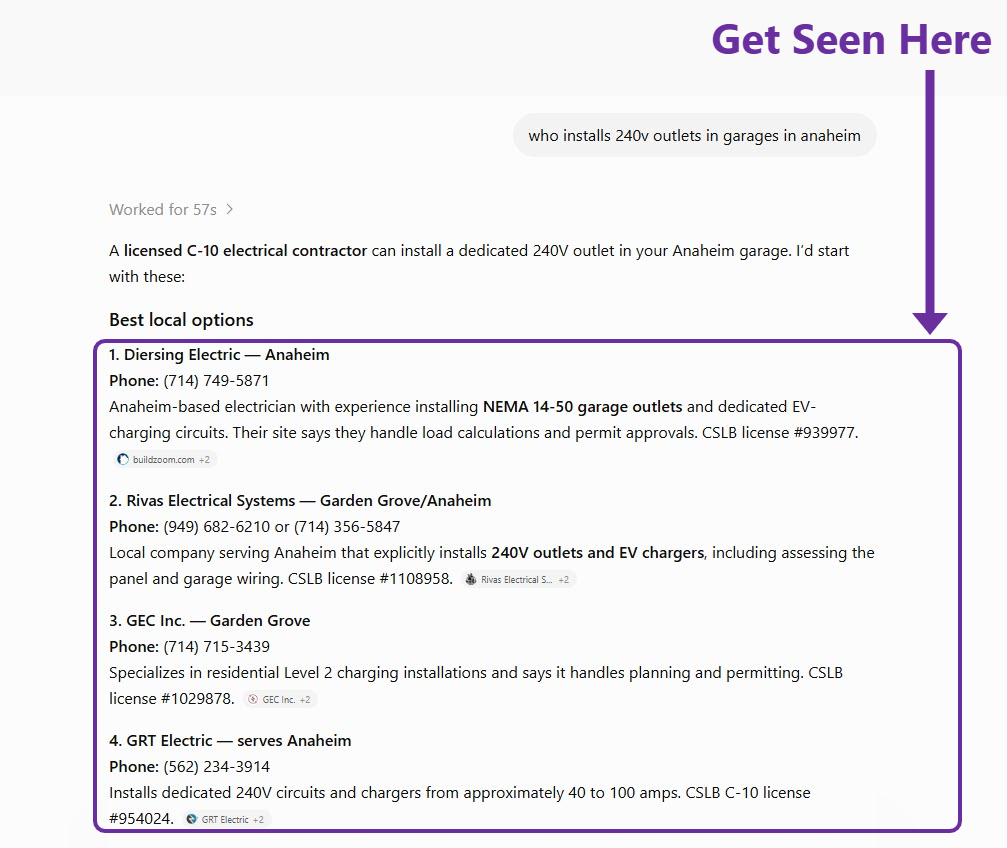
ChatGPT · Google AI Overviews · Google AI Mode · Gemini · Perplexity · Claude
Google now answers "who installs 240v outlets in garages in anaheim" before it shows a single search result. Three electricians get named above the map pack. Everyone else is a scroll away.
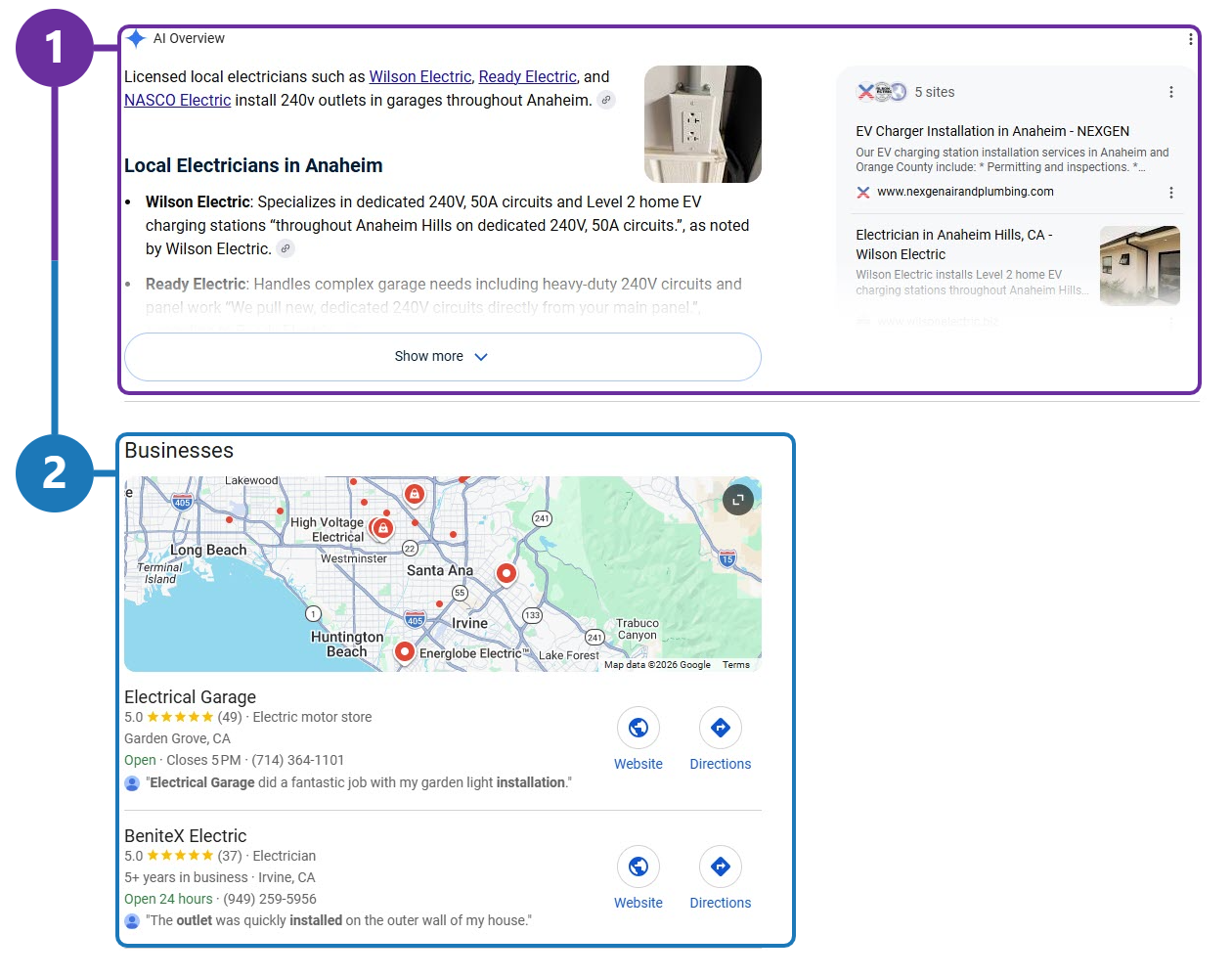
1. The AI Answer
2. The Map pack. Different rankings, different businesses, fewer calls.
7 days for $1, then $49/mo. Cancel anytime.
Her breakers keep tripping before a remodel. By the time she's finished asking ChatGPT who to call, she has three names — and you're not one of them.
AI tells the homeowner the panel is undersized, then names the electricians who upgrade it. Every answer without you in it is a four-figure ticket on someone else's board — and unlike a lost bid, you never learn it existed.
Your trucks cover thirty miles. Your website covers one city. The neighboring towns call the electrician whose pages actually mention them by name — and those same pages are what an AI answer reads before it decides who to name.
No agency, no learning curve, no waiting a quarter for a strategy deck. Start this week and see the difference by next season.
A clear score for panel, rewire, EV charger and emergency work across all six engines. Your first honest picture of the channel.
Find out which electrician gets recommended instead of you, and exactly which signals to strengthen to take their place.
The agents write the pages and build the authority behind them. The fix ships instead of sitting in a to-do list.
Scheduled scans show visibility climbing. The phone tells you the rest. Keep what works, drop what doesn't.
7 days for $1, then $49/mo. Cancel anytime.
Same work, three payoffs — the profile, reviews and pages that put you in the map pack are the same ones that get you named in the answer.
You get named. When a homeowner asks ChatGPT or Google whether a panel needs upgrading — and who to call — your company is in the answer. That's the version that produces the phone call.
You get found locally. Every service you sell and every city you cover gets its own page, its own Google Business Profile posts, and the code Google needs to place you on the map. You show up in the suburbs you've been losing.
You get trusted. The credibility signals AI engines and Google both weigh get built month after month, without buying links you'll have to clean up in a year.
A homeowner asking "do I need a panel upgrade for this, and who should I call?" is deciding a four-figure job in a single response. Being the company named in it is worth more than any ranking report — and it costs less than one service call a month.
Watched, so no source of calls goes unmeasured
You serve gets its own pages, built to rank
To start — less than one service call
You'll know, service by service and city by city, whether AI sends homeowners to you or past you. Marketing spend follows evidence instead of a hunch.
See who AI recommends instead of you and what earns them the mention. Then close that gap deliberately, before they notice there was one.
A full set of local pages — written in your voice, with the Google Business Profile posts and code handled — so you rank on the map and get named by AI without hiring a writer.
Build tiered links on Google's own properties in a few clicks. The trust signals that move rankings, with no footprint you'd have to disavow later.
Powered by LABS, Keyword Agent and Off-Page Agent — all included in every plan.
Everything you've been told about SEO for the last twenty years was written to win a click on a page of ten blue links. That isn't where homeowners are deciding anymore.
BFE is built entirely for the right-hand column. Your existing SEO keeps doing its job; this covers the part nobody is covering yet.
An AI answer names three or four electricians. There's no page two, no "close enough," no second chance to be considered.
Right now almost nobody in electrical work is competing for those spots. That's exactly why they're winnable this year and won't be next.
And pages take a season to earn their place. Whatever you want ringing during remodel season gets published well before it.
7 days for $1, then $49/mo. Cancel anytime.
Every plan includes every app and agent we launch, one shared credit pool, and 3-month credit rollover. Whatever you pay today, you pay for as long as you stay.
Find out where you stand and start closing the gap in your main market.
7 days for $1, then $49/mo. Cancel anytime.
Enough runway to cover every service and every city you actually sell.
7 days for $1, then $144/mo. Cancel anytime.
For multi-location shops and contractors running several brands.
7 days for $1, then $444/mo. Cancel anytime.
Increasingly, yes — and you don't have to take our word for it. Ask ChatGPT or Google who installs 240v outlets in garages in your city and look at whose name comes back. Google now puts an AI answer above the map pack for exactly those searches, so this reaches homeowners who have never opened ChatGPT in their lives.
Your plan renews at its normal monthly price — $49, $144 or $444 depending on which you picked — and you can cancel from inside the app at any time before or after. No contract, no cancellation call, no annual commitment.
No. Most owners start by running a scan to see whether the work they're already paying for is showing up in AI answers. If it is, you've got proof. If it isn't, you've got a specific conversation to have — and the pages and links to fix it either way.
Plan on an hour to set up your services and cities, then roughly thirty minutes a month to review and approve what the agents produce. You approve; the agents write, post and build. You are not writing content or chasing links.
AI mentions can shift within a few weeks of new pages going live. Map pack and organic rankings move on a slower curve, usually a season. Scheduled scans show the climb the whole way, so you're never guessing whether it's working.
That's usually where the fastest wins are. Every service gets paired with every city you cover, so you compete in the suburbs your trucks already reach — where the competition is thinner than it is downtown.
It's written from your existing site's voice and your ideal customer, so it reads like your company rather than a template. You review everything before it publishes.
Not the way this is built. The tiers sit on Google's own properties rather than link marketplaces, so you get the authority without a footprint you'd have to disavow if the rules tighten.
Start for $1, stay month to month, and cancel from the app whenever you want. Unused credits roll over for three months, so a slow shoulder season builds the balance you'll want at peak.
Start the whole platform for a dollar and see what AI says about your company.
7 days for $1, then $49/mo. Cancel anytime.
Almost every electrical job starts with uncertainty. A homeowner doesn't know whether tripping breakers mean a bad circuit or an undersized panel. They don't know what an EV charger install really requires, whether their wiring is safe, or what a permit involves.
Those are exactly the questions people now hand to an assistant instead of opening ten electrician websites. The assistant answers. Then it recommends. In one response the homeowner learns the panel needs upgrading and gets three companies to phone about it.
If your name isn't there, the job never enters your pipeline. Unlike a lost bid, you never even learn it existed. That's the exposure: the trade's biggest tickets are increasingly awarded before a website is opened.
AI engines don't invent local electricians. They assemble answers from what the web already says about you — review volume and recency, state licensing and bonding, a complete and active Google Business Profile, consistent listings across directories, mentions on sites that carry weight, and pages that genuinely cover the work you do in the places you do it.
That's good news for a well-run company. You don't need to game anything. You need the things you're already good at to be legible: written down clearly, structured so a machine can read it, and backed by enough credibility that the engine feels safe naming you.
Most electrical sites carry a handful of service pages and a list of towns on the contact page. To a search engine — and to an AI answering a question about one specific suburb — that reads as a company rooted in one city that happens to travel.
The electrician with a real page about EV charger installation in that suburb, with local markup and recent Google Business Profile activity, looks like the local option. Fixing it is unglamorous and effective: every service you sell, paired with every community you cover, plus the questions homeowners actually ask around each one. Panel sizing. EV charger requirements. Permits and inspections. Knob-and-tube and aluminum wiring. Done properly it lifts map pack rankings and gives AI engines something specific to cite at the same time.
Good content on a site nobody vouches for tends to sit still. Historically the fix meant buying links, which works until it doesn't and leaves a mess behind. Building tiered links on Google's own properties is a different proposition — high trust, no marketplace footprint, and nothing you'd have to disavow if the rules tighten.
Put the three together. Know where you stand. Publish content worth citing. Earn the credibility behind it. Do that and AI SEO stops being a buzzword. It becomes the reason the phone rings through remodel season, in every town your trucks can reach.
Get named by AI
7 days for $1, then $49/mo